
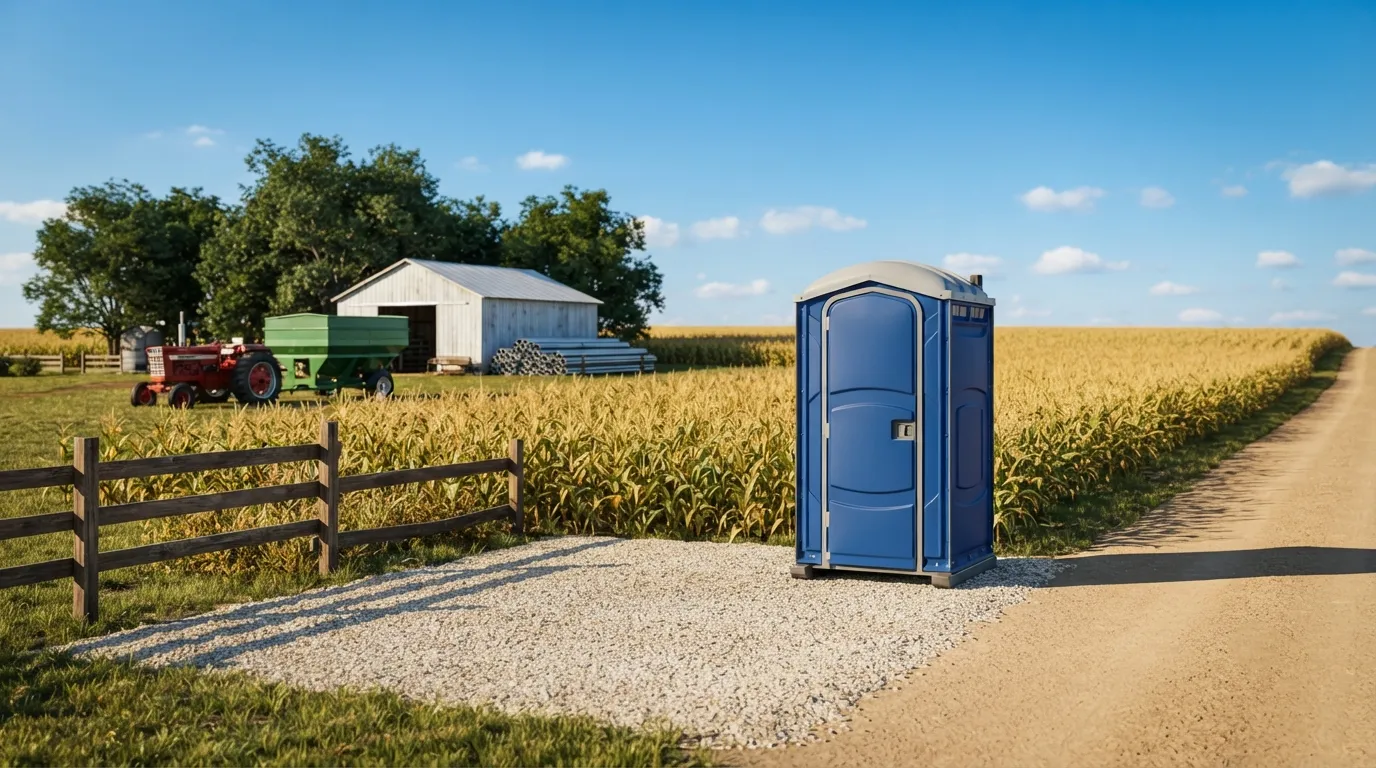
What Restrooms Does a Farm Operation Need?
Farm work moves crews across acreage all day, so the standard rule of thumb is one unit close enough to reach without losing work time. OSHA 1928.110 sets that distance at a quarter mile for hand-labor employees, plus potable water and handwashing at the same stop. That is a different standard than a fixed construction site, where OSHA portable toilet requirements under 1926.51(c) scale by headcount instead of distance. A farm with pickers spread over several fields usually needs more than one placement point rather than one big cluster. We plan around your rows, your equipment paths and your harvest schedule, not a generic grid.
Our standard porta potty rental units carry a 60 to 70 gallon holding tank and stand about 92 inches tall, sized to survive a season of heavy daily use without a mid-week pump-out. For crews doing pesticide or herbicide application, washing facilities are required under OSHA 1926.51(f)(1), which covers paints, coatings, herbicides and insecticides specifically. That is separate from general toilet counts, and it means a handwashing station rental or portable sink rental belongs on-site whenever spray work happens, not just at harvest. Check our porta potty placement guide before delivery day so the truck has clear access to soft ground or a field edge.
How Many Units Does a Seasonal Harvest Crew Need?
Crew size drives the count, and the field sanitation standard scales the same way ratio-based toilet rules do. Use our how many porta potties do I need guide to size a crew of 15 pickers against a crew of 60. A single porta john rental unit handles a small family operation near Union City fine, while a larger seasonal push benefits from two or three units staged at opposite ends of the property. ANSI/PSAI Z4.3 sets a baseline service interval of once a week for up to 10 users over a 40 hour week, so a bigger crew or longer hours means more frequent visits, not just more units.
| unit | duration | typical price |
|---|---|---|
| standard | day | $150 |
| standard | week | $200 |
| standard | month | $200 |
| dumpster | week | $600 |
| dumpster | month | $108 |
Between harvests, if the crew shrinks, a monthly porta potty rental usually costs less per day than booking short daily terms back to back. Farms running year-round hand-labor operations, like nursery or greenhouse work, often keep one unit on standing rent and add emergency porta potty rental units only during peak weeks. Pair restrooms with a roll-off dumpster rental for crop waste and packaging, since farm sites generate as much trash volume as a small construction job.
Do Farm Restrooms Need to Meet ADA Requirements?
Farm labor sanitation under OSHA 1928.110 does not carry the same accessibility language as a public event, but any site open to visitors, agritourism guests or a farm stand still benefits from accessible planning. ADA Standards section 213.2 requires that where portable units are clustered, at least 5 percent, and never fewer than one, be an accessible unit. Our ADA accessible porta potty units meet the 32 inch clear door opening called out in ADA Standards 404.2.3 and the 60 inch turning circle in section 304.3.1, which matters if the farm hosts a pumpkin patch, wedding venue or seasonal market alongside labor operations. A farm running a public-facing event should look at our event restroom rental and festival restroom rental pages for guest-facing counts separate from crew counts.
Water access matters too. OSHA 1926.51(a)(1) requires an adequate supply of potable water at all places of employment, which on a farm usually means a water trailer or tank paired with the restroom stop. If your operation includes a farmhouse, bunkhouse or packing shed with a septic system, seasonal labor spikes can push that tank past its limit faster than a typical residential schedule of every 3 to 5 years. Our septic pumping service and septic tank pumping cost pages cover what a pump-out runs before harvest season hits. Farms within reach of Hillside, about 2.5 miles east, or Roselle, 3.7 miles south, fall inside our standard delivery zone alongside Union City proper.
How far in advance should I book for harvest season?
Book two to three weeks ahead of your first harvest date. Seasonal demand across Union City and nearby towns climbs fast once picking starts, and unit availability tightens. Early booking also gives us time to walk the property and plan placement around equipment paths.
Can I move units between fields during the season?
Yes. We coordinate relocation as your crew moves across acreage, usually as part of the same rental agreement. Tell us your rotation schedule up front so we can price moves into the term instead of billing each one separately.
Do you service units on unpaved or muddy field access roads?
Our trucks handle most gravel and packed dirt roads without issue. Soft mud after heavy rain can delay a scheduled pump-out, so we recommend a gravel pad or firm turnaround near the unit location, especially during spring planting.
What happens if a unit runs out of tank capacity mid-week?
Call us and we will schedule an early pump-out, usually within a day. Crews that scale up fast during peak harvest often need a mid-week service added temporarily, which we can build into the existing schedule rather than a one-off emergency call.
Do farm restrooms need handwashing stations separate from the toilet?
Yes, when pesticide, herbicide or insecticide application is happening, OSHA 1926.51(f)(1) requires washing facilities for that contaminant exposure specifically. A standalone hand sanitizer station rental does not satisfy that washing requirement on its own.
Next step
Get a delivery date
Tell us the address, the dates and the headcount. We size the order and confirm the route.