
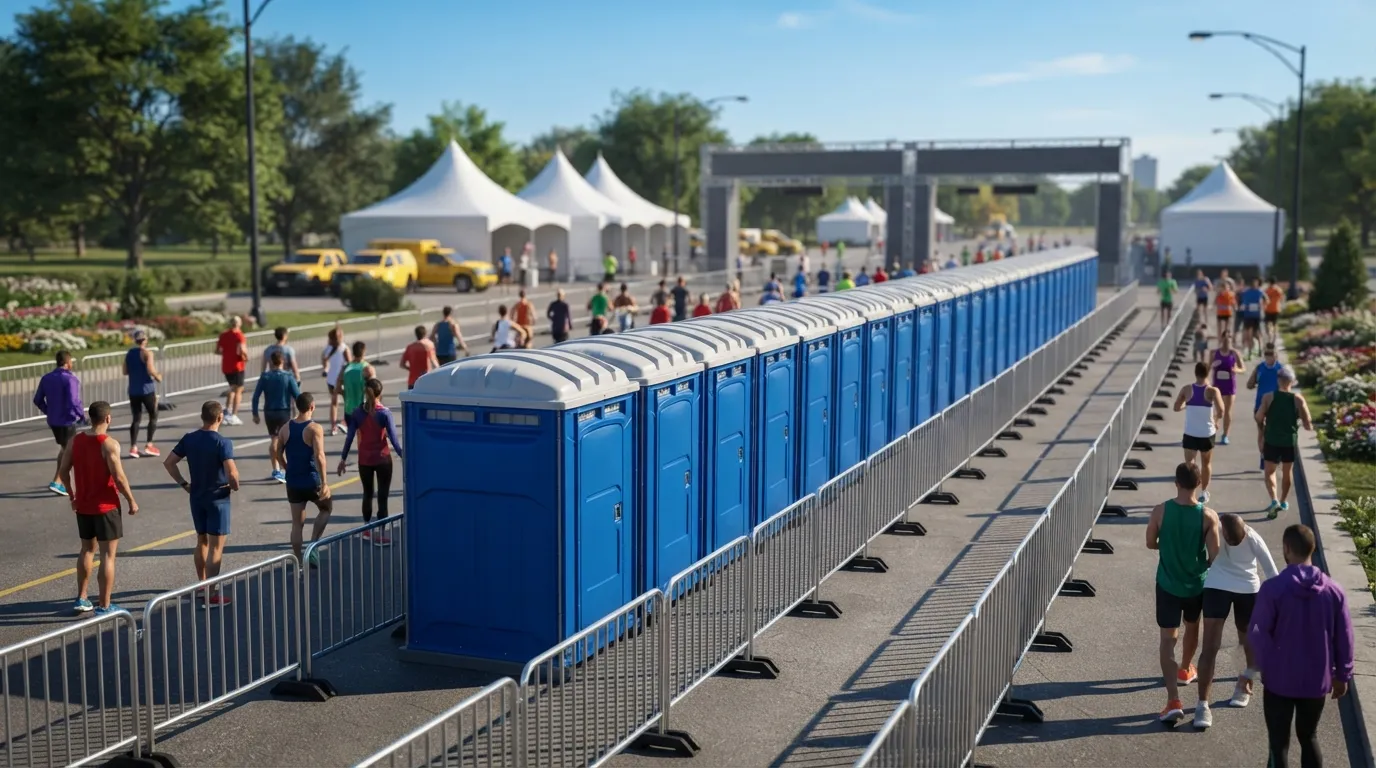
How many restrooms does a marathon need?
Start with the field size, then split it three ways: start chute, aid stations, finish area. A 2,000-runner race typically calls for around 10 standard units, following the same logic contractors use under OSHA 1926.51(c), which sets 1 toilet for 20 workers or fewer and scales up from there. Races aren't job sites, but race directors use that ratio as a starting point because it's the only tested benchmark available. Spread units at the start, add 2 to 4 at each aid station, and put the biggest block at the finish festival, where runners and spectators stack up for hours. If you're not sure where to start, our guide on how many porta potties you need walks through field-size math in more detail.
Every cluster needs at least one accessible unit. Under ADA Standards section 213.2, where single-user units are grouped, at least 5 percent of that cluster must be ADA units, and never fewer than one. That's true at the start line in Union City and it's true again at mile 8's water stop. We also stage deluxe flushable units near VIP or sponsor tents when race organizers want something nicer than a standard unit for a smaller group.
Where should race restrooms be placed along the course?
Placement follows the route map, not guesswork. Units go at the start corral, every aid station, and the finish chute, set back from the running lane on stable, level ground per ADA Standards section 302.1, which requires floor and ground surfaces to be firm and slip resistant. Service trucks need clear approach lanes, and a roll-off or restroom trailer delivery needs about 60 feet of straight clearance behind the truck, so we walk the course with organizers before race day to flag any tight turns near barricades or timing mats.
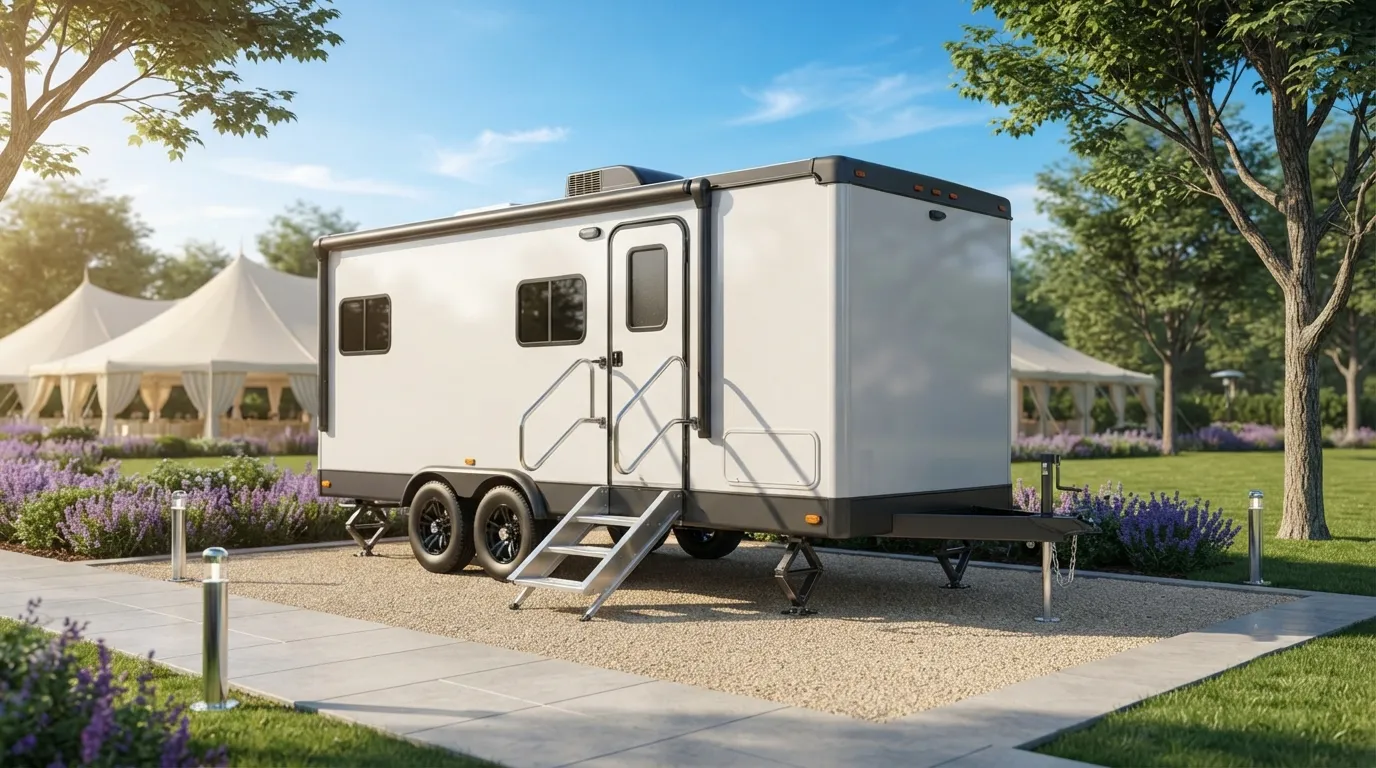
If the finish festival includes vendor tents, generators, or a stage, you're likely also renting temporary fencing and a light tower for early-morning setup. Power matters here too. If your finish line uses a temporary power pole for timing equipment or announcer sound, brace it properly: guy-wire the pole at three points, anchor each wire to a driven stake or ballast block, and keep the base clear of runner traffic. A pole that shifts under wind load can take down a timing system mid-race, and GFCI protection under OSHA 1926.404(b)(1)(ii) still applies even on a one-day event. That's the same bracing method crews use whenever they need to know how to brace a temporary power pole on any job site, race day or not. For bigger finish festivals, a restroom trailer at the VIP or media area gives sponsors something better than a standard line of units, and our 8 stall trailer handles high-traffic finish zones without a long queue.
Can I get restrooms for just race day, or do I need a longer rental?
Yes, single-day and weekend rentals both work, and most race organizers only need units for the event window plus setup and breakdown. A standard unit runs in the range other race directors pay for one event day, and weekend rates apply if your festival runs Friday load-in through Sunday teardown. Larger multi-day races, like a stage event or a festival tied to the race weekend, sometimes book by the week instead.
| unit | day | week | month |
|---|---|---|---|
| standard | $100-$350 | $130-$500 | $125-$325 |
| ada | $200-$400 | $200-$400 | - |
| deluxe | $85-$1,200 | $150-$290 | - |
Weekend standard-unit pricing runs $125 to $400 for the block, which covers most two-day race weekends without a full weekly commitment. Delivery adds a separate fee, and our cost breakdown page explains how delivery, service, and unit charges stack for an event this size. If your race draws runners from Hillside, 2.5 miles east, or Roselle, 3.7 miles south, we can stage a second delivery route to hit both the Union City start and a satellite lot without adding a rush fee.
Handwashing stations belong at aid stations and the finish festival, especially near any food vendor tents. Under 29 CFR 1910.141(d)(2), washing facilities need soap and towels or a hand-drying device, and hand sanitizer alone doesn't satisfy that. We also recommend a stand near medical tents, since race day scrapes and blisters get treated there all morning.
How far in advance should I book race restrooms?
Book as soon as your course map and permit are set, ideally 4 to 6 weeks out for a large field. Units, trailers, and fencing all get reserved fast during race season, and last-minute orders sometimes mean substituting standard units for the deluxe or trailer option you wanted.
Do I need ADA units even for a small local race?
Yes, if you're clustering units anywhere along the course. ADA Standards section 213.2 requires at least one accessible unit per cluster, no matter how small the field is, so even a 300-runner local 5K needs one ADA unit at the start and one at the finish.
What size trailer works for a finish line festival?
It depends on runner count and dwell time. A 2 stall trailer suits a small local race, while festivals with a beer garden or long award ceremony often need a 4 stall or 8 stall unit to keep lines short.
Can the same order cover packet pickup the day before?
Yes, we can deliver early for expo or packet pickup, then service units again before race morning. Just flag both dates when you request a quote so the service schedule lines up with your two-day footprint.
What about restrooms for the race committee's post-event cleanup?
A single standard unit or a small roll-off dumpster usually covers breakdown crews. Check our roll-off dumpster page if the festival leaves behind vendor waste that needs hauling the same afternoon.
Next step
Get a delivery date
Tell us the address, the dates and the headcount. We size the order and confirm the route.